
“The goal in filmmaking isn't to be fully representative but to tease out the humanity and contradictions of characters.”
Warning! This article contains spoilers for “One Battle After Another”.
Banseka Kayembe
Awards season has been exhausting this year. From the BAFTAs “n-word” incident which led to days of public conversation that repeatedly flattened or outright ignored the intersections of race and disability, to the bizarre online hunt for an “Oscar villain”, the discourse has lurched from one strange fixation to another. The latest target appears to be Timothée Chalamet, who clumsily suggested that cinema risks going the way of ballet or opera (culturally revered but no longer widely consumed) and was promptly treated by social media users, opera theatres and ballet performers as if he’d committed a spree of mass killings. The less said about that perhaps the better.
If we can bear to cast our mind back to several unhinged discourses ago, the timeline was obsessed with something else: the depiction of activists and revolutionaries in Paul Thomas Anderson’s film One Battle After Another. With awards season finally staggering toward its conclusion (thank God) it feels worth returning to that now-cooled debate. What should our expectations actually be of art when it comes to politics and activism? Are we harming or betraying communities or movements when we do not depict an absolute truth about those involved? What is the balance between having expansive artistic storytelling and taking responsibility about how it might be perceived in the wider world?
We want to keep our journalism independent, people powered, with no paywalls and away from big corporate and billionaire funders- but we need your help!
Please consider becoming a subscriber or making a one off donation, for as little as 99p
It’s certainly not the only 2025 film to be dabbling in politics, there’s the BAFTA winning intimate, human story My Father’s Shadow, the historical Brazilian thriller The Secret Agent, the hugely popular period horror piece Sinners, and the powerful dramatisation The Voice of Hind Rajab. One Battle After Another follows a network of radicals, fugitives and organisers called The French 75 fighting a police state and navigating the blurred lines between political struggle and personal survival. Its characters are generally not presented as heroic symbols so much as contradictory people shaped by ideology, desperation, flaws, personal desire and circumstance.
All of these films in some way prompt questions about political struggle, but there was a considerable amount of criticism towards One Battle After Another, largely because of the character Perfidia (played by Teyana Taylor), who is only in the first thirty minutes but whose shadow haunts the entire narrative. Perfidia is in my view a complex character, inhabiting a complex world. Her self-ascribed name suggests both glamour and danger, but underneath that exterior she seems vulnerable too.
She repeatedly shifts her loyalties in ways that are difficult to fully decipher. At various points she appears to seduce, manipulate or betray the men around her, sometimes advancing the aims of the movement and at other moments seemingly undermining it in pursuit of more selfish, adrenaline-driven desires. It's difficult to separate her own urge for autonomy and personal thrills, from a desire to shape the world, often through violent means. Her first encounter with the white supremacist military man Colonel Lockjaw (Sean Penn) is a confusing picture of power play dynamics, sexual desire, narrowed choices and off the cuff political strategising.
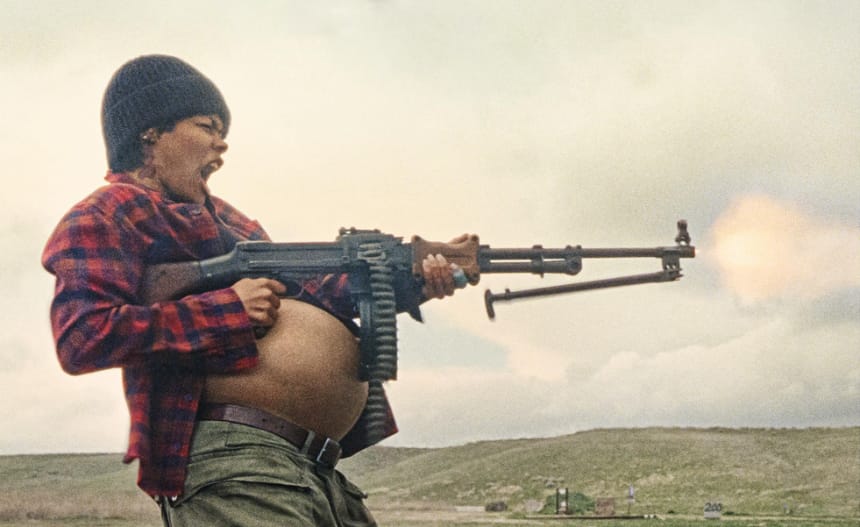
She demonstrates a carefree attitude to her pregnancy; I think the visceral image of Perfidia firing rounds of ammo with a swollen pregnant belly are some of the most indelible cinematic images of this century. She takes enormous, sometimes comically uncalculated political risks including actions so horrendously bad that she ends up ratting out her comrades to the state, abandons fellow revolutionary Bob (Leonardo Dicaprio) and their newborn child, and goes into hiding. Perfidia and to a lesser degree her comrades, live out to an extreme how many of us perhaps feel these days: like there is no tomorrow.
It is these actions that have led some viewers to read her as a racial cinematic trope; the hypersexualised, duplicitous “Jezebel” whose power lies primarily in her ability to control men. Ringer podcast host Van Lathan described the character as an “abomination,” and “someone’s fetish fantasy” because she is so antithetical to how real life black female revolutionaries are. She was "grotesquely selfish and unaware that everyone that she met was worse off because of it. It's an interesting standpoint to watch a white male director put a black female character like that” in a film. I understand the reluctance to embrace what can feel like “bad representations” of marginalised characters, especially at this incendiary time. Hollywood has a long history of flat, empty black characters that don’t showcase the spectrum of feeling that gives them a believable sense of humanity.
Yet Teyana’s performance itself complicates that reading. Perfidia is played less as a calculating puppet-master than as someone constantly assessing the danger of the room she is in, her charm and flirtation often registering as tools of survival rather than pure manipulation. Small gestures (hesitation before committing to a decision, the flicker of uncertainty behind a confident façade) suggest that her choices may be driven as much by coercion, fear or improvisation as by deliberate strategy. When Lockjaw tracks her down into a bathroom mid-violent revolutionary act, she freezes, arms gently spread against the wall with him standing behind her. She’s vulnerable and clearly in a tight squeeze; there’s an implication she is under duress to engage in certain activities with the Colonel in order to escape.
Her final letter to daughter Willa (Chase Infiniti) at the end of the film exhibits a sense of personal shame and fear. The film never fully resolves these tensions, leaving Perfidia suspended between her own deep personal flaws and the pressure cooker of the system she has had to find a way to self preserve in, in order to survive. She’s not a hero, like Pam Grier in Tarantino’s Jackie Brown for example, but I do not think she’s the film’s villain either. No one seems to be able to explain why she should become an avatar for all black female revolutionaries (and there are multiple depictions of different black female activists within the film).
The film presents a philosophical provocation for us: would it be better if Perfidia was a more saintly or martyr-like figure for the sake of better representation, or can we allow a more liberal remit to artists where individual marginalised characters can do things that make us feel uncomfortable for the sake of a probing, layered, interesting story? Taylor stated in an interview recently of the racial dynamics around her character: “I think we don’t enjoy seeing the harsh reality”. I’m minded to agree that discomfort does not have to always equal “bad” or “wrong”. The goal is not to be fully representative but to tease out the humanity and contradictions of characters. A story should be able to ask if this particular person existed, what would happen? How would they be shaped and moulded? What actions would they be led to pursue? What journey would they go on? That feels pretty fundamental to artistic expression.
There is a respectability politics trap that it is easy to fall into when discussing cinematic representation. Some understandably hope that if marginalised people are depicted in sufficiently dignified, admirable or morally exemplary ways, this will translate into better treatment in real life. Representation, in this view, becomes a kind of cultural assimilation project: proof that marginalised groups are respectable, rational and deserving of empathy.
Media can undoubtedly shape individual attitudes and bring injustices into public view, but it cannot, by itself, do the structural work of dismantling systemic racism, imperialism or social inequality. This logic can produce a very particular kind of warped storytelling, where marginalised groups are expected to embody virtue, resilience and moral clarity at all times, stripped of contradiction and complexity. The result is a sanitised and ultimately unconvincing character, the kind historically rewarded during awards season but rarely remembered by audiences. Films such as The Help, Driving Miss Daisy and Green Book offer narratives about racism that are carefully smoothed into palatable, easily digestible moral lessons. The characters themselves become symbols of dignity rather than fully realised people, and the stories fade quickly because they feel less like life and more like a 101 political handbook.
The film has also had allegations of being “anti-revolutionary” a cinematic CIA psy-op. Some have suggested that its portrayal of fractured movements, shifting loyalties and compromised characters risks reducing radical politics to chaos, futility and incompetence; it’s true that you get the impression many characters are acting out a simplistic style of revolutionary politics with little concrete theory behind them.
Yet the film actually offers several different visions of what political commitment might look like. There is Sensei’s (Benicio Del Toro) quieter form of activism rooted in community and care, a politics less interested in big spectacle than in sustaining relationships and grassroots local solidarity. In subverting a trope-y Liam Neeson-in-Taken style finale, Willa’s arc represents yet another perspective: a younger generation’s tentative optimism, suggesting that political energy does not disappear even when movements fracture or fail. Rather than delivering a clear “Revolutionary Tactics for Dummies!” message, the film seems more interested in showing its multiple textures; the idealism, the improvisation, the compromises, intergenerational back and forths, and the persistence that coexist within any political struggle.
That kind of nuance increasingly doesn’t seem to be what people demand from films. Often viewers seem more interested in a neat, singular message to take away which can be a blueprint for change in real life, reflecting the political moment we are living through. Trust in traditional sources of information has eroded, no one knows what's real or isn’t any more (even Jim Carey’s face) newsrooms are shrinking and the information environment has become more chaotic. The line between reporting, commentary, promotion, criticism and cultural storytelling is increasingly blurred. In that vacuum, audiences often turn to popular culture for guidance on how to interpret the world around them. Art begins to carry expectations that once belonged to journalism, documentary film making or political analysis. But cinema, however politically engaged, cannot fully bear that weight. A fictional film cannot do the same job as a documentary. Fiction can illuminate injustice, provoke questions or shape emotional understanding, yet it cannot provide the definitive clarity that functioning public institutions are supposed to deliver.
In the end, asking whether One Battle After Another is pro- or anti-revolutionary misses the point. The film does not present a clear political programme so much as a series of tensions. It asks questions rather than offering tidy answers. Narrative cinema that attempts to resolve political struggle too neatly risks becoming simplistic, even propagandistic, and perhaps worst of all, dull. Politics rarely provides linear, tidy resolutions anyway. More often, political victory unfolds the way the title suggests: through one battle after another.
Thanks for reading our article! We know there's power in people and really appreciate everyone who reads our work.
Give us a follow on Instagram and TikTok to see more of our independent journalism.