
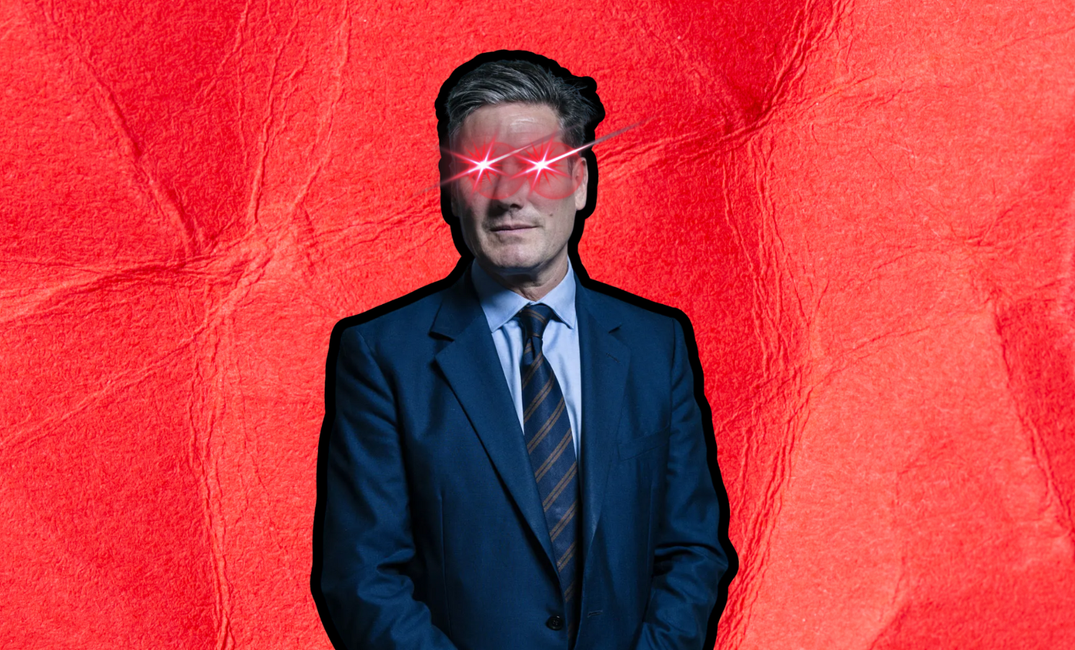
Investigative journalist Paul Holden speaks to us about political fraud, media manipulation, and the quiet destruction of Labour Party democracy detailed in his new book "The Fraud".
Banseka Kayembe
He’s becoming a remarkably hated figure in British politics, quite possibly the most unpopular Prime Minister of all time. Keir Starmer, a man who’s got less substance and charm than an empty plastic bag floating in the wind, is the man everyone loves to hate- but we know relatively little about him.
There is perhaps no better work I’ve come across that picks apart and analyses Starmer than investigative journalist Paul Holden’s "The Fraud”, a mammoth book that lays bare how Britain’s Labour Party was reshaped from within — not through open political debate, but by covert campaigns, media manipulation, and the systematic crushing of the left. Drawing on leaked internal documents and years of forensic investigation, Holden traces how a small network of political operatives through the misleadingly named group "Labour Together" engineered a project that would ultimately deliver Keir Starmer to the leadership, at immense cost to democratic accountability inside the party, and arguably the public.
We want to keep our journalism independent, people powered, with no paywalls and away from big corporate and billionaire funders- but we need your help!
Please consider becoming a subscriber or making a one off donation, for as little as 99p
Holden’s work sits at the intersection of corruption reporting and political history. Having cut his teeth investigating grand corruption and the global arms trade in post-apartheid South Africa, he brings the same rigour to British politics — unlike many British journalists he treats the factional warfare not as empty Westminster gossip, but as a serious democratic problem.
Banseka: I found “The Fraud” incredibly meticulous. Were there ever any moments where you felt like you might come across as a conspiracy theorist at times? This is the type of thing that could very easily be dismissed by mainstream media as just silly fractional Labour Party infighting that's not necessarily relevant.
Paul: Yeah, absolutely. I think the thing that helped a lot was that I had from right from the beginning a really rich documentary source: a huge leak out of the Labour Party, which I sort of lucked into getting in 2021, 2022 and it is a really substantial set of documents. It's literally emails between people and that lends a real weight to the investigation. .
Quite a lot of the investigative work was attempting to place certain people together at a certain time, and then you can draw an inference here. When I look back at my first draft that I wrote it's a lot more like piecing together little fragments of information into a narrative, because that was what was available in addition to my documents. But then the amazing thing was that as Labour Together and this political project came closer to power, the more they just bragged about what they’d done anyway.
Banseka: Was it hubris?
Paul: It was hubris. The moment that my mind was blown was basically in April 2023, Labour Together relaunched itself on its website, and it suddenly came clean about everything it's been doing, saying they were initially started to fight the hard left, that they ran a campaign to take back the party from communism and then they supported Keir Starmer’s campaign. It was like, oh, you're just saying everything? I pieced together over two years, but now you're bragging about it.
Banseka: I think that's a problem when you get used to basically zero scrutiny and zero challenge and you're so successful. They're obviously wildly successful at the way they managed to destroy the left, but it does give you a sense of impunity and thinking “actually, we can just say the thing. We can just say what we've been doing!”
Paul : Yeah, I'm always amazed by some of the other books that have been written about this as well from a more favorable perspective by the journalists who characterise these actions as “smart or strategic”. I'm reading it and thinking they've actually admitted some serious, profound, unethical misconduct!
In British politics I think the easiest job in the world must be to be a right-wing Labour MP in opposition. You don't have to do anything, you do policy announcements that nobody takes seriously and then the media treats you brilliantly because basically you're punching the left all the time. They get all these like fawning profiles and full page interview spreads and as a result, I think they get a bit lazy and complacent.
Banseka: It did make me laugh when you included screenshots from Morgan McSweeny’s LinkedIn bio side by side showing totally different information, because it just seemed so absurd! Most people are at least vaguely familiar with Keir Starmer; obviously Morgan McSweeney is less well known. What’s his origin story? Who the hell is McSweeny?
Paul: It's a really, really interesting question, because Morgan McSweeney has never given an interview on the record. The only thing I found in years of obsessively trying to find out everything I possibly could about him is one video from 2019 posted to Facebook addressing a crowd, which has subsequently been taken down.
I think there's two things that really strike me. The one is, it does seem like he just genuinely despises the left, thinks that the left is evil, and I think he has contempt for the soft left. His politics from all the profiles have been written about him, basically circles around like a “Blue Labour” tendency, which is a pretty marginal tendency in our politics in general, but really marginal in the Labour Party.
And the other thing that strikes me about him is just the number of people I've spoken to who feel like they've effectively been taken in by him. So he's extremely competent and he's plainly very charming. He has a way of presenting himself to people that comes across as extremely reasonable, very affable, kind. He's extremely good at convincing people that he needs to work with for whatever reason that he has a totally different politics to what he actually has.
The Changing Politics podcast for example has a whole episode about how we need to be helping asylum seekers and refugees, including a 15 minute long interview with a guy who arrived in a small boat, and it's written by Morgan McSweeney, who is now overseeing one of the most brutal crackdowns on the asylum system in British political history.
I really feel like this guy has no limits to how or what he'll do in pursuit of destroying the left as a political goal. This behavior is almost normalised, but it's not normal behavior. Normal people don't set up fake astroturf campaigns, or demonetize news websites because they're reporting critically on people you support. That's mad stuff.
Banseka: You make sense of something which I think for a lot of people has been very confusing and very difficult, which is the use of antisemitism by the Labour right to essentially crush or annihilate their political enemies.
With everything that's now happening in Gaza, which you cover in the book as well, do you think that's made it easier to talk about? We've perhaps now got more understanding publicly about how antisemitism can be weaponised?
Paul: I think the difficulty with the issue of antisemitism was this concept of “denialism” which became so toxic. If you look at all the evidence that's submitted proving people are antisemetic basically from late 2018 onwards, it's people saying, “I don't think the antisemitism crisis is as serious as people think” or “we think it's being used cynically” and that itself was treated as a form of antisemitism. That was a very effective campaign.
But I do think Gaza changes things in most people's minds, because if you have a situation where a children’s TV presenter like Miss Rachel is being called an antisemite I think most ordinary people will think that's very weird. But I don't think that sentiment has really crossed over and people in Westminster; certainly the media class, don't seem to fully understand how profound Gaza has been for a lot of ordinary people, including people who are not necessarily political in the UK but have seen a genocide taking place on their phones.
For a lot of people, this is the first time they've experienced something that a lot of people on the left have as their daily experience, which is to have a reality you can see in front of your face misdescribed by the media, and then your anger at the reality you see, coded as a form of like bullying or hate or something.
When I wrote the book, I was obviously worried that you'd have actors come out saying I was minimising antisemitism or being antisemitic, but nobody takes those accusations very seriously anymore, and it's made for a more fertile ground for the book to land, and for this issue to be discussed.
Banseka: I do wonder if there is going to be a shift soon around how useful quite a lot of politicians think antisemitism will be.
Paul: Within the Labour party there is a hierarchy of racism but also a hierarchy of antisemitism. It's an actively hostile place if you're a left-wing Jewish anti-Zionist. You've been told repeatedly, again and again, explicitly at times that you are not welcome in this party, that you are a self-hating Jew. That's mad.
Banseka: I think you paint a really interesting picture of Keir Starmer as someone who’s an empty vassal and doesn't really have full control of the reins. Mainstream media has at times painted him as someone lacking ideas but generally an "inoffensive" man. At the same time you explore his quite a draconian approach in the criminal justice system during his time at the CPS. How much of the government’s strategy is actually Starmer?
Paul: I don't understand why anyone would call him "inoffensive" when he cut the winter fuel allowance and it took him a year to [lift the two child benefit cap and] take children out of poverty?
Banseka: Yeah, it’s ridiculous framing.
Paul: I don't try to present a profile of Starmer in any sort of meaningful way because it's an investigative book and I'm actually focusing on revealing wrongdoing, so I can't really speculate that much about it. However, I do have a sense that Starmer has no politics. He's not a deep thinker about political economy at all, which is actually very rare in British politics and in the Labour Party in particular.
Generally speaking, Labour leaders have, in various different ways, really had a deep, profound sense of their political moment and a clear diagnosis of why society is the way it is, what doesn't work about society, and where to go to improve it. So even though Tony Blair is not my politics, I can see that Blair was a thinker who has a diagnosis of how society functions. Similarly with Gordon Brown, or Ed Miliband who is from an incredibly distinguished family himself, they are deep thinkers about politics. I think Starmer primarily sees himself as a manager.
In some ways Starmer must be so confused, because I think he thought that the job of being Prime Minister was that he was going to convene a whole bunch of very smart people who had been telling him for years that they knew exactly what they were doing, manage them and do the stuff he really likes which is flying around the world meeting leaders, shaking hands and having a couple of meetings, whilst they get on with the hard stuff. Because of that, there's basically no vision.
Starmer really doesn't seem to like conflict that much; it's a very common theme when I speak to people in his constituency when they've tried to confront him and he'll basically say anything in a moment of conflict to get out of it. But I also think Starmer has a very clear sense of where power resides in society; basically his sweet spot is doing the bidding of other powerful agents and I think he quite likes being able to cloak himself from the authority of their institutions. I think he's a bit of a coward basically.
It's also striking how authoritarian he is, but he's only ever authoritarian and hardline to people who have less structural power than him in society. When the Black Lives Matter movement happens, he'll take the knee, but he's got no truck with the idea that the police don't do their job properly, right?
Banseka: That was the moment I knew I was giving up my Labour party membership, by the way.
Paul: If you look at his political trajectory, he basically has succeeded in his professional life by at various times doing what powerful people around him tell him what he should do, in order to achieve success.
As DPP (Director of Prosecutions at the CPS) he comes in and does whatever the security state wants him to do and really is a pretty awful DPP from that perspective, then he becomes a leader of the Labour Party and he's basically told by powerful people “you should do this to win power…you must lie to the membership about who you really are and what you believe but then you must transform the party in this way, you must deregulate everything, and if you do all this, all the glories will come to you and you'll have this glorious career.” He's also quite an odd character in the sense that he's not particularly charming; you speak to most people who have had an engagement with him and they find him a little bit weird. Like there's something that he doesn't quite gel with people naturally.
Clearly there's a political class of media journalists who still see him as a nice guy, but there's really nothing there. There's no substance to this guy. Even if you read Tom Baldwin's biography, it's an odd experience because Baldwin clearly likes Starmer, but also wants Starmer to be something, to be a political character of substance. And he's constantly trying to drag out of Starmer, what are your beliefs? What do you believe in? And there's just nothing there.
Banseka: It just kind of strikes me as a total crisis of democracy really, because what you're almost saying is “Starmerism” is irrelevant because he's largely empty, and really we should be talking about McSweeneyism.
Paul: I think that the best way to think of Starmer is as a political player. There was an early Tory attack line on Stammer when he was first elected, which basically was that Starmer is a lawyer and so he will just represent whatever brief is put in front of him, that he has no core beliefs. Actually, I think that's not a bad read on him. “Other people come up with ideas, they give me a brief and then I will then represent these policy ideas to the best of my ability, like a barrister. But if you have a different set of policy prescriptions in a year's time, which contradict these ones, it doesn't matter because I've taken on a new case.”
I don't hold much of a candle for McSweeney but basically, he's got two primary skills, right? One is running election campaigns. The other one is managing media narratives; and these skills often cross paths. It's incredible the extent to which McSweeney was behind the antisemitism crisis, placing stories in the media. It's an incredible act of skill to work with multiple media outlets to create a narrative about antisemitism -really weaving it out of almost nothing- that becomes totally uncontested. By 2020, it's an effectively incontestable fact about our society, right, a political fact, which is still very hard to disrupt. That's a real skill.
But what does McSweeney know about governing? What does McSweeney know about the economy at a deep fundamental level? What does this guy actually know about what is good or ethical for our society and how to get there? In the book I write about the Red Shift report [written by Labour Together] which shows a total contempt for core Labour voters and the majority of Labour MPs at the time. It even explicitly says the public doesn't share the same views as the majority of Labour members, Labour voters and Labour MPs, therefore we should ignore these groups. I guess that's why half of the people who voted for the Labour Party in 2024 are now thinking of voting for the Greens.
The second thing Red Shift tries to answer is: “how do we win power?”. That's it. It doesn't say “what do we do with power?” It also doesn't ask the question: "are we going to win power in an ethical way? Are the ways that we're going to win power going to tie us to a set of policies that are even achievable?" It doesn't even consider these as questions to be contemplated. The document just says we need to poll the public, and the public says this, and therefore we must represent these views to the public.
It was so abundantly clear that when they came to power, they would have really very little to offer in terms of how society can be changed for the better…This a recipe for a serious crisis, not just of democracy, but of like the Labour Party. This is now getting existential.
Banseka: Right, like it is now feasible to think that the Labour Party will get 100 or less seats at the next election.
Paul: That means that this political project has single handedly basically destroyed a hundred year old political institution that has actually at times been quite good for us. Like that is a tragedy.
Banseka: Are you hopeful in any way that there will actually be any material consequences around these very serious sort of issues that your book brings up? Misuse of funds by Labour Together in particular?
Paul: It's very hard to know. I've already been extremely disappointed by the response from the Electoral Commission, which has basically been to say” there's nothing to see here”. They are still refusing to release its investigative report into Labour Together, even after all of the stuff that I've put in the public domain, it just doesn't make any sense… We need to understand how our Prime Minister came to be.
So from that perspective, I am very skeptical of our regulators and to be totally frank, that's not unusual for somebody who works in anti-corruption; you spend a lot of time knocking on closed doors until they open. The brutal reality of anti-corruption work is that often they're only open when political circumstances change.
Some people, sadly people like McSweeney and Steve Reed will land far more comfortably because they're tied into much more wealthy networks. But I think Starmer is going to leave and he's going to be the least popular prime minister in British political history, on par with Liz Truss. His political reputation is destroyed, totally destroyed…I can see that there is a level of panic amongst the new intake MPs, and there's a lot of people whose political reputations are being destroyed by association.
This interview has been condensed for publishing purposes
“The Fraud: Keir Starmer, Morgan McSweeny and the Crisis of British Democracy” by Paul Holden is published by O/R Books and is available to purchase.
Thanks for reading our article! We know there's power in people and really appreciate everyone who reads our work.
Give us a follow on Instagram and TikTok to see more of our independent journalism.