
When Kaouther Ben Hania first heard six-year-old Hind Rajab’s cries for help, she believed cinema could do what social media could not: force people to reckon with the reality of Israel’s genocide in Gaza
This interview does contain spoilers for the film “The Voice of Hind Rajab”.
Cinema has countless ways of provoking emotion, but few are as devastating or as inescapable as the voice of Hind Rajab herself. On 29th January 2024, on a mobile phone, the six-year-old begged Palestinian Red Crescent emergency responders to save her from a car in Gaza City that was shot to pieces with bullets, surrounded by the bodies of her murdered family members following an Israeli military attack. Tragically, the ambulance was just eight minutes away. Permission from all the right authorities was sought, the “right” procedures were followed, but Hind did not survive.
Nominated for Best International Feature Film at both the BAFTAs and the Academy Awards, The Voice of Hind Rajab asks audiences to do something uncomfortable: to listen to Hind in her own words during what would be her final hours.
Director and screenwriter Kaouther Ben Hania first heard Hind’s voice on social media, and couldn’t forget it. In this interview, she reflects on the ethical weight of centring Hind’s real voice, the decision not to depict her physically on screen, and why cinema can act as a form of necessary pressure in the absence of justice and accountability from our political institutions.
Naked Politics: Did you always know you wanted to use Hind’s actual voice as part of the film? What were the ethical considerations or questions that you had if any around that?
Kaouther Ben Hania: The story started when I heard Hind Rajab's voice. It was all over the internet, published by the Red Crescent who recorded her voice and their conversation with Little Hind. When I heard her voice for the first time, her voice was so impactful that I thought that social media is not the right place for something like this, because this girl needs to be heard, remembered. Her voice needs to be honoured.
We want to keep our journalism independent, people powered, with no paywalls and away from big corporate and billionaire funders- but we need your help!
Please consider becoming a subscriber or making a one off donation, for as little as 99p
And that's why I thought by doing a movie around her voice that maybe people will sit in a dark room, which is a movie theatre, and listen, because on social media nobody listens, it's about scrolling. It's the right place to not only listen, but also to understand and to see what happened to this little girl, and to remember her.
Because I'm a filmmaker I had to consider all the other options; [such as] to take a child actress and to ask her to mimic Hind’s voice, which for me was not very respectful for the memory of this little girl.
And it’s a huge problem of mise en scene you know, because you have this testimony, it needed to be heard, and to be heard widely.
Naked Politics: We never see Hind, other than via real family photos. Can you talk us through why you felt it was important not to have her physically depicted?
Kaouther Ben Hania: Showing her physically meant that I would be doing something more classical, like going back and forth from the two sides of the phone, and bringing an actress and doing the mise en scene of the death of this child.
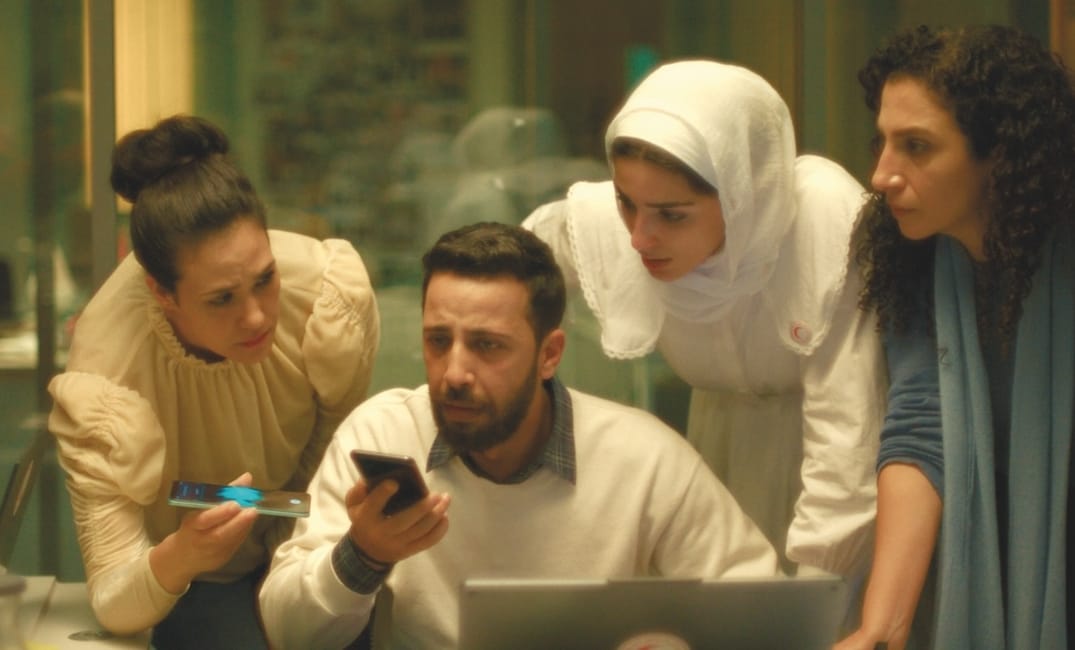
I wanted to avoid this because for me this is problematic. I didn't want to do this movie to make a spectacle out of the killing of this little girl. I wanted to honour her voice and to let her be remembered. So the right place for me as a filmmaker was to be with those who listened, those who did everything in their power to save her. And those people are the Red Crescent employees.
In a way, it's a movie about us also, about our helplessness. Their position of listening to this girl, doing everything in their power to save her, and being forbidden, being denied. Their helplessness, anger and sadness is an echo for us around the world.
I'm not the kind of filmmaker who likes filming graphic violence. Choosing to put the camera in an office is not the most spectacular choice for a filmmaker, but I didn't want this movie to be spectacular. The purpose wasn't to make a spectacle out of it. I needed to film another kind of violence that we don't talk about often, which is the violence of the rules. In this story, you have this little girl trapped in a car surrounded by the dead bodies of her family, and you have an ambulance eight minutes away. They can't send their ambulance because the Israeli army will bomb it, so they need to follow a long procedure to coordinate with the Israeli army who shot the family of this girl, so they can send an ambulance to save this girl without the Israeli army bombing their ambulance.
For me it is a very violent situation, this is the violence of rules imposed by design, imposed by the dominant force on those Palestinian aid workers. Their job is to save lives, but they can't. They have these rules that are making their life impossible, and the life of this little girl impossible in a very literal way.
And the Israelis don't even respect their own rules, because the Palestinians and the Red Crescent follow every procedure. They got the green light from the army so they could send their colleague without them being killed, and the Israeli bombed them. So this is very violent and for me being in those offices is a way to show this silent violence, and to avoid making a spectacle out of this story.
Naked Politics: The film also demonstrates competing or conflicting ideas of the different colleagues in the office about the occupation itself. There's a moment where one of the central characters Omar says to his boss: “it's because of people like you that we are occupied”. It prompts a very difficult conversation about what choices, if any are available to people who are occupied and colonised.
Kaouther Ben Hania: This was very important for me to show because both of those characters wanted the same thing. They wanted to save this little girl, but they are not talking from the same point of view; Omar is the one who answered this little girl Hind and he thinks that all this is useless and he needs to send his colleague to save this little girl immediately, whereas Mahdi thinks because he's responsible for sending them, he don't want them to also die because of his decision. When you were talking about the impossibility of choices, this is a perfect example.
This is the situation when you are under occupation. I know something about it because of the history of Tunisia and of Algeria, which is another kind of colonialism but the mechanisms are the same. You have a dominant power that is imposing on you, so you don't have a lot of choices.
Naked Politics: Hind seemed to have a real knowledge that she really was in danger. There was no childhood innocence to protect her, like we might normally assume a child has. Your film does a good job of slowly unwinding that reality; the children of Gaza do not even have that shield of innocence really, because they have grown up and lived in such a violent space.
Kaouther Ben Hania: In the film we see that Rana at the Red Crescent, in a way wanted to make sure that Hind thinks that all her family are sleeping so she tells her let them sleep; she's trying to shield and protect her, but Hind tells her they are dead. So we realise that even for this little child, because of this situation she's getting quickly matured. When you are a child growing up in a place like Gaza, your life is not like a normal child. You don't have a normal childhood.
Naked Politics: The film is Oscar nominated, and received a standing ovation at Venice Film Festival which is of course a significant achievement. Do you have any conflicting feelings or emotions about that? That it’s possible for a film documenting Palestinian oppression to be considered for such accolades, but at the same time the world has failed in its responsibility to prevent these atrocities.
Kaouther Ben Hania: When I started doing this movie, I was advised to not do it right now, “the genocide is still going on…wait for like five or ten years”. And I was thinking, wait for what? I needed to do this movie now because there is no accountability with the Israeli army. I believe in the power of cinema, that it can be a tool of pressure, to have some justice.
This is something that Hind's mother told me when I called her for the first time and said “I want to do this movie, but if you tell me don't do it, I'll not do it because it's your child”. She told me she wants justice for her daughter, so if this movie can help in a way, please do it. So I needed to do this movie right now, to be a tool of pressure, a tool of change.
My purpose from the beginning was to echo the voice of Hind Rajab all around the world. We live in a world where you need to be nominated for an Oscar so people who know nothing about Palestine or Gaza may go to the theatre and see another perspective. One of the sentences I kept hearing from audiences was “this movie changed me.” And this is the first step for change.
I don't have many tools, but I have this formidable tool called cinema, and I think it's an effective tool because it can change the narrative and the narrative is something very important.
Thanks for reading our article! We know there's power in people and really appreciate everyone who reads our work.
Give us a follow on Instagram and TikTok to see more of our independent journalism.