
Banseka Kayembe
An interview with the co-authors of Friends in Common on why friendship may be one of the most important antidotes to our socio-economic misery.
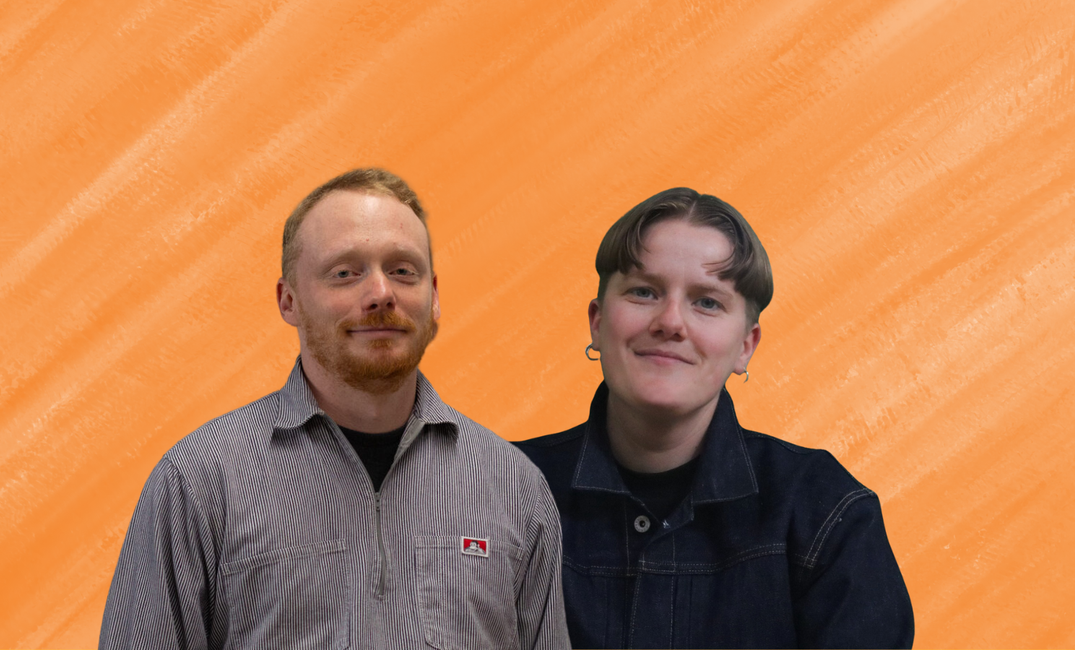
Friendship is often dismissed as something personal and private, but as historian Laura C. Forster and anthropologist Joel White argue in their book “Friends in Common Radical Friendship and Everyday Solidarities”, it is one of the most potent forces we have for building community and sustaining resistance. Their work traces how friendships form across boundaries of class, age and identity, and how those ties can open up new political possibilities in a world that increasingly isolates us.
We sat down with them to talk about writing together, the radical history of affinity, and why building a world worth living in still depends on each other.
Naked Politics: First of all, are you guys friends?
Laura: Really good friends! We met through a friend in common, and we'd both been thinking a bit about friendship, looking at it from slightly different ways. Joel is an anthropologist, and I'm a historian. After a while of hanging out we were like, maybe we should put we should try write something about this? Now we're best pals, so we're already thinking of what we can write next.
Joel: It's been one of the joys of my life to write this book with someone who I didn't know at the start, and then become friends with through doing it. The ultimate aim of the book is to think about how we can embolden and build struggle against the capitalist system we live under, and we need each other to do that; I think a lot of us feel isolated. I would recommend finding yourself a friend to write with.
We want to keep our journalism independent, people powered, with no paywalls and away from big corporate and billionaire funders- but we need your help!
Please consider becoming a subscriber or making a one off donation, for as little as 99p
Naked Politics: Did you find any of it hard? Reading the book it feels like you have a singular voice; it's a real collaborative effort.
Laura: Maybe it is because of the topic of the book? It feels sort of meta because if we're writing about committing to other people, then we really should be doing it in our writing relationship as well. There were of course times where one of us was doing a bit more, but then we tried to be together in person as much as possible, and do things collaboratively, not just via email.
Naked Politics: You write about friendship having a radical capacity; under capitalism even our most personal relationships can get co-opted. There’s a really interesting example you use of how the Marxist term “emotional labour” gets captured to then mean the labour done in personal relationships, rather than the exploitative emotional labour done at work. How does capitalism capture and shape the notion of friendship?
Joel: I feel like I was drawn to the term “emotional labour” when we were writing about that together, partly because it's been through so many cycles in the online washing machine, it's just been like, rinsed out completely.
The anthropologist, Alice Hochschild looked at how people would have to perform certain feelings and emotions at work in order to succeed, and that these were managed by quite tight parameters. You were penalised or rewarded depending how you performed. The emotions of being welcoming, happy or sweet to customers potentially, for example an airhostess.
I think then it got captured. In the book, we talk about how these groups of seemingly mainly middle class, American, white women in the US talk about emotional labour as having to do things like remembering to buy Christmas cards. That feels kind of silly when you go back to the original Marxist analysis that Hochschild was making, but then actually when you expand beyond productive labor, as we call it in Marxist terms, to social reproduction, there's other kinds of labour that sustain the economic system, right?
I feel like that's probably one of the areas of contemporary life where I'm feeling most despondent; it becomes quite hard sometimes, to almost separate the parts of yourself that are doing that, from your core or the real emotion. Sometimes you're just so used to performing for work that you kind of lose track of who you are a bit. We wrote about a friend of mine who's a tattoo artist. The advice she's had from various other tattoo artists is that if you want to make money, you've got to make people not just appreciate your art, but want to spend several hours with you, while you tattoo their body and have this intimate and friendly encounter. She found that quite difficult in the long term, because these were parts of her that she was giving to that relationship, that then in a weird way ended up eroding her other friendships.
If our general, wider argument is that there's something about friendship which is quite difficult for capitalism to co-op, how do we still be really honest about the ways that it is managing to do that? A lot of our deep intimacies and forms of relations are shaped by the system and this kind of need to hustle, work and be online.
Laura: People's frustration with friends, people's ideas about the disposability of friendship, makes more sense when understood in this world that we're all in, where actually we are forced to use up so much of our energy on “friendship type stuff”, but not to friendships end, but to the ends of this capitalist meat grinder.
I think writing this book made me slightly less romantic about friendships, as I had to grapple with some of the really difficult elements and be a bit more realistic about it. But I've also realised just how vital it is. It's life or death, so I really do think that that makes me hopeful, because, what else is there except to have to hope?
Naked Politics: There's been a lot written about the idea of living in a frictionless world, which basically involves you talking to as few people as possible while you go about your day. We don't actually have to interact with anyone, because you'll just scan your own stuff at the shop, or don't have to talk to someone to order your Uber. Therefore, any small bit of friction or tension that comes from natural human relationships, feels like a big deal.
Laura: This self optimisation rhetoric is so damaging, in part because it says you should have as few interactions as possible. We've all got quite bad at forms of conflict…because of this idea that friction is always bad, so we sort of pull back from it.
Naked Politics: The book explores some Luddite history, and you write about the perception of friendship (whether real or imagined) and the power that has to compel people into political action. What power is there in imagining a wider network of relationships?
Laura: The Luddites were not a legal group, because at that time you can't legally combine at work against your bosses. They were mostly textile workers, but not neatly condensed into one industry. Often they’d smash a machine in protest and they'd leave a threatening note, signing it “Captain Lud” and they’d talk to each other in the radical press: “Captain Ludd has told us that we should all do XYZ”. There actually was no Captain Lud, this is an invented leader. What's interesting about that is these are quite disparate workers, so it becomes a way of creating an imagined community through which to channel this feeling of being impoverished both literally philosophically, by the way capitalism is rampantly increasing.
Captain Lud became a mythical figure that allowed people to express a collective identity. I think trade unions can make you feel that there's power in a collective, that you're not alone, and that you have the shared struggle, but doing that with this imaginary figure was just this very powerful attachment to the idea of a collectivity to push back against these new manifestations of capitalism in the 19th century.
Naked Politics: You have a really interesting conversation with another friend about the concept of intergenerational friendships and the dangers of using each other as generational “resources” rather than seeing them as just people.
Joel: Whenever I go back [home] for Christmas, at Christmas parties most other people get asked “what are you doing with your life? Have you got a job yet?” And my older friends ask me, “Have you brought the struggle forward? How have you built the left in the last year?” Which is a scary question, actually!
These people are very active in the climate movement, Palestine Solidarity, into their 70s and 80s. Paying attention to them helped me get out of a slightly knee jerk, anti-generational feeling that a lot of us have, particularly in our teens, one that was kind of encouraged materially by the fact that younger people have got a raw ideal economically compared to some previous generations. I think the real question for radical struggle is: how do we build across those generations in a way that names a common enemy for us to fight against? Gargi (a colleague at publisher Pluto) who we interviewed also talks very beautifully about how we can work to include older people in our organising, and the challenges of that. Because it's not always easy.
Laura: Britain is one of the most age-segregated countries in the world, so there’s less opportunity for people to find themselves in an intergenerational situation. Online platforms are so corrosive particularly with intergenerational conflicts or differences that can be extremely fraught, and online it becomes a shit show. There’s no generosity on those platforms purposefully, no room for deliberation across age groups. There’s then a lack of social centres, political spaces, publicly owned spaces, more private spaces and all that feeds that generational antagonism.
We tried to frame history as a kind of intergenerational friendship, a way of talking with the past, not in finding and extracting what we need from you, or “you did this and that wrong”, but how do you converse with the past as a way of thinking through the possibilities across generations. We tried to think about history, how we are open to thinking and learning across time, it’s not easy as there’s so much to be frustrated about and there’s lots of ways we’re pitted against each other, by the media but also exacerbated by these platforms.
Even the ideas of generations themselves is a kind of a marketing thing; categories created for who to sell what to. These platforms exacerbate that, and make room for political differences or discussion around difficult, things that are misunderstood feel impossible. Friendship being difficult and reciprocal and needing space and time, and needing our energies but all of the ways we give that are being eroded.
Naked Politics: I agree, you get rewarded a lot on platforms for trying to do a Boomer v Gen Z take, which isn’t always appropriate or useful.
You write about friendship being a good vehicle for messaging- much of how we communicate is through online platforms like Whatsapp, Zoom or social media. Is it possible to use friendship as a medium for messaging under techno-capitalism?
Joel: It’s very hard. I think there’s people who are trying to rebuild alternative ways to communicate within the shell of these techno-feudal platforms. There’s a crew of people in Glasgow I know who have been building their own websites from scratch with servers in their bedrooms, some people are ditching their smart phones. I’m deeply addicted to Whatsapp, I'm not sure how to extract myself from it. But it does also seem to be “enshittifying” itself; the app homepage is full of AI prompts I never asked for. If anything kills it, it may be them themselves to a degree.Younger people I talk to have never experienced the last vestiges of a better online world, they’ve only experienced the monopolised version we have now.
I do think people are finding other ways to imagine what the internet could be, and it can be a space for real connection particularly for maginalised communities.
Laura: The 19th century anarchist and socialist lecturers we write about in the book, they have these new technologies like the telegraph, and yet they were still insisting on face to face stuff because otherwise you can’t build movements. So we can similarly think about friendship in that way. Increasingly being with each other in person is the best way to subvert some of that. We don’t always have the spaces for it, and not much time but it’s so key. We kept coming back to that and even at different points in history where technology has allowed for more instant forms of communication, some of those slower ways of having to deal with the difficulties of actual people, such as letter writing and slower forms of communication, have yielded really important ways of thinking about friendship.
Naked Politics: You start the book with an interesting provocation, which is that friendship can, in some instances, trump identity. I’d love to know what you mean by that; I know identity can often bind us to others but there’s something interesting about the radical possibility that friendship could help us reach beyond the confines of what are capitalist identities?
Joel: “Affinity is a better grounds for organising than identity” is the quote i think you’re referring to. I think our understanding of that is not to say that identity is not important. The last ten years of discourse around identity politics has been pretty toxic to be honest, but I do think the lens of affinity and interpersonalness as a starting point to organise and build coalitions is important. Not saying “who am I?” but “who do I want to be? How will the other people around me be encouraged?" We can consider the affinities in our lives across differences and start organising from there. To be in solidarity you do need to be open to change and let go on some of the attachments we have around identity. Not so much doing away with identity but orientating more towards an affinity.
Laura: I don’t think being totally aligned or the same to be friends is true, I think we’re often made to feel like that partly because of the way things are sold to us. Capitalism says you should just be friends with people who have the same hobbies, and you have to do the same things with people, so there’s less friction because you’re doing stuff you all like together and that could be perfectly valid, but radical friendship offers something different.
It suggests it’s not just about where our identities or interests align in a clear cut way, but what it means to have forms of solidarity that don’t demand everything be totally comfortable for me. Maybe it does feel tricker because we have the same broad goal, but besides that we might have quite different ways of approaching things. The suggestion of friendship is not so much about aligning our identities or interests but rather offering a space to have that deliberation or discussion. Solidarity is easily broken if we’re sorted into our categories, and that makes it easier for our enemies.